Refrigerator Repair
Why a Sub-Zero Stops Holding Cold in Phoenix Heat
A built-in that drifts warm in July is usually losing the fight at the condenser, not at the compressor. How to tell dust and ambient heat apart from a real sealed-system fault before you pay for the expensive guess.
Written by
Warren Ibarra
Refrigeration technician — condenser and heat-load work · 20 years in the trade
There is a particular call we take from the middle of May to the end of September. The refrigerator was fine in April. Now the milk is turning by Thursday, the compressor seems to run all afternoon, and by morning everything reads normal again. Nothing has broken in any obvious way, which is exactly why it gets ignored until something does.
That pattern is not a random fault. It is a built-in running out of margin in Phoenix summer conditions, and the causes are few enough to work through in order.
What “not cooling” actually means on a built-in
A Sub-Zero built-in is not one refrigerator. It is a cabinet with, depending on the model family, one or two sealed systems, separate evaporators for the fresh food and freezer compartments, a condenser and fan at the base or the back, a defrost circuit per evaporator, and a control board reading several sensors at once. “Not cooling” can be any link in that chain, and the compartments fail independently.
So the first useful thing is not a diagnosis, it is a measurement. Put a thermometer on the middle shelf, not in the door, and read it after the door has been closed for a couple of hours. Then read the freezer. Write both numbers down with the time. A cabinet at 46°F with a freezer at 0°F is a completely different fault from both compartments sitting in the fifties, and the second one is far more likely to involve refrigerant or a compressor.
Start at the condenser, because that is where this city wins
Every refrigeration system works by dumping the heat it removes from the cabinet into the air around it. The condenser coil is where that happens, and the condenser fan is what drives room air across it.
Phoenix dust is the problem. Fine caliche dust, blown in through open doors and pulled in by the fan, builds up into a mat across the fins that behaves like insulation. The coil can no longer shed heat, head pressure climbs, and the compressor spends longer and longer running to achieve less and less. Add a kitchen sitting at 82°F because the AC is losing its own fight, and the unit has nothing left in reserve.
Symptoms of a choked condenser look alarming and are cheap to fix:
- long run times that get longer through the afternoon and ease off at night
- the grille area noticeably hot to the back of the hand
- freezer holding better than the fresh food side
- a fan that sounds louder than it used to, or has started clicking
Pull the base grille and look. If the coil looks grey and furry rather than like metal fins, that is your first suspect. A vacuum and a soft brush, with the unit switched off, will tell you within a day whether it was the whole problem.
Read the ambient temperature before you read anything else
Built-in refrigeration is rated to work within a stated range of surrounding air temperature. That number was never written with a closed Phoenix garage in July in mind, and a garage installation is common here — a second unit for drinks and overflow, put where there was room for it rather than where the air is kind.
Before condemning any part, measure the air at the condenser inlet. If that air is 105°F, the unit is not faulty. It is being asked to do something outside its design, and no part swap will change the answer. What helps is airflow: clearing the space around the grille, adding ventilation, or accepting that a cabinet in that location will hold a few degrees warmer than the panel claims all summer.
The same logic applies to a built-in against a west-facing wall, or beside a range where the exhaust dumps across the top of the cabinet. Heat entering the box has to leave again, and the further away the surrounding air is from comfortable, the harder every other component has to work.
When the fresh food side is warm and the freezer is fine
This is the most misdiagnosed pattern on Sub-Zero equipment, and it is almost never a compressor.
On a dual-evaporator built-in the two compartments are cooled by separate evaporators. If the freezer is hard frozen, the sealed system is moving heat successfully — so the fault sits on the fresh-food side of the airflow. In order of likelihood: the fresh-food evaporator fan has failed or is running slowly; a damper or air duct that feeds that compartment is blocked or stuck; the fresh-food evaporator has iced over because its defrost heater or sensor has gone; or the control board is no longer calling for cooling on that circuit.
Every one of those is a repair rather than a replacement, and most of them are a single part. It is worth knowing that before somebody quotes a new cabinet.
What is worth a service call, and what is not
Some of this is genuinely worth doing yourself. Cleaning the condenser, clearing space around the grille, checking that the door closes and seals, and logging two temperatures over a couple of days cost nothing and rule out the most common causes.
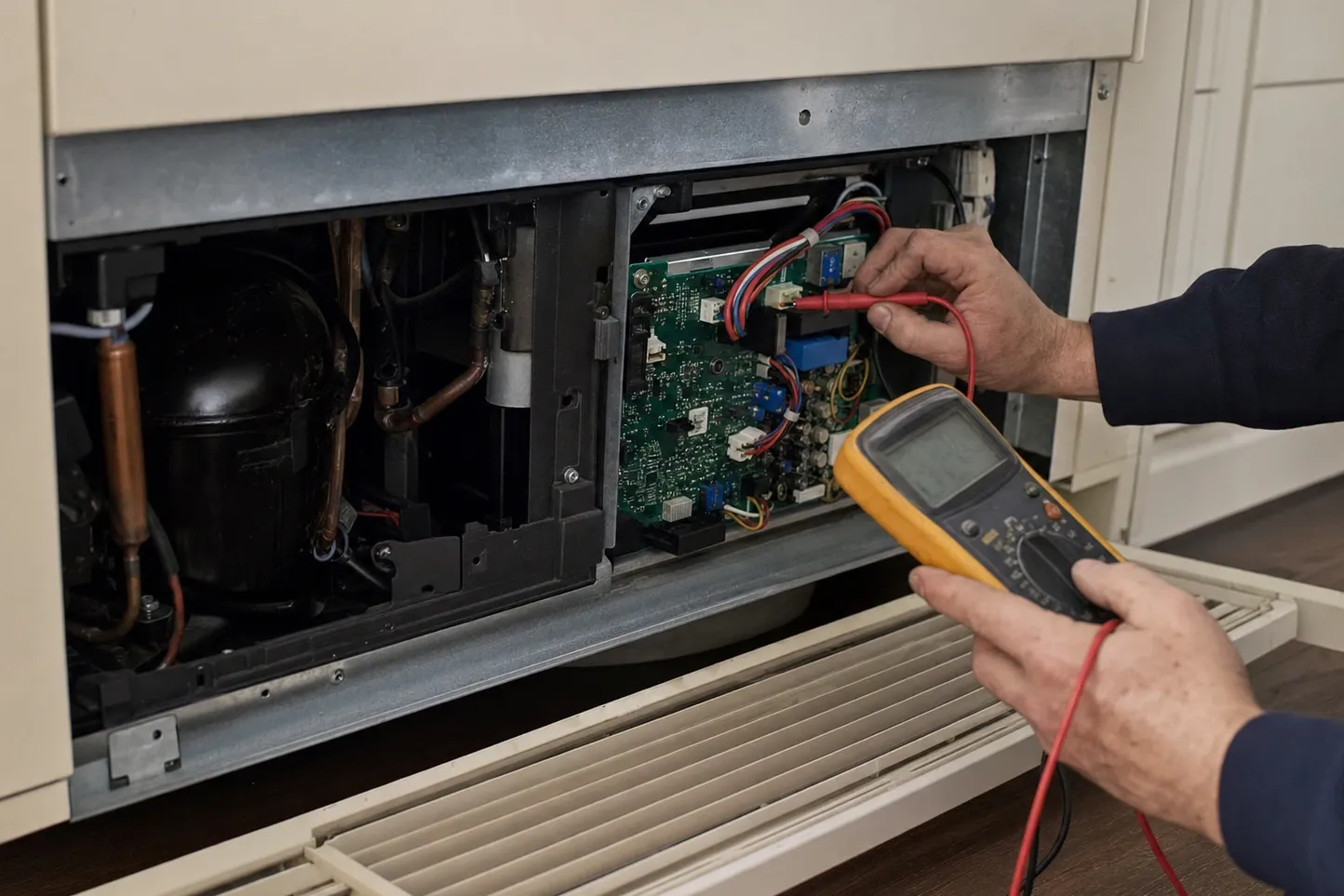
Call somebody when the readings say the unit has a fault rather than a disadvantage: both compartments warm with the compressor running, frost on one evaporator and not the other, a fan that does not turn when it should, a cabinet that never recovers even overnight, or a compressor that starts, buzzes and stops. Those need gauges and a meter, and guessing at them is how a valve repair turns into a compressor bill.
The honest version of this trade is that a good half of the summer calls in this valley end at the condenser. It is worth ten minutes with a vacuum before it is worth anybody’s van.
Follow-up questions
- How often does a condenser need cleaning in Phoenix?
- Twice a year is realistic here, and once before summer is the one that matters. Fine caliche dust builds a felt-like mat across the coil far faster than household dust does elsewhere, and a matted coil is the single most common reason a built-in drifts warm in July.
- Is it normal for a built-in to run almost constantly in summer?
- Long run times in a 110-degree kitchen are normal; never satisfying is not. If the cabinet holds its setpoint and the compressor rests even briefly, the unit is coping. If it runs all afternoon and the temperature still climbs, something is wrong and it is measurable.
- Can a refrigerator recover on its own after the house cools down overnight?
- Often yes, and that is the trap. A unit that recovers overnight and fails again every afternoon is telling you it has no headroom left — usually a restricted condenser or an ambient problem. Waiting for it to fail permanently just makes the food loss worse.